People
What does someone need to enter, understand, and keep going?
Audience strategy, belonging, interpretation, learning pathways, and usable choices.
Education strategy · systems design · public learning
Working across institutions · networks · public life
Practice / 00
I’m Yesenia Pérez, an education strategist, program leader, researcher, and writer working across higher education, NASA science education, museums, and national partner networks.

I work on the space between an ambitious idea and an experience people can actually use. That means following learners, partners, decisions, resources, evidence, and the rules that determine whether progress continues or stops.
People
Audience strategy, belonging, interpretation, learning pathways, and usable choices.
Institutions
Recognition, governance, program strategy, funding, implementation, and accountability.
Networks
Partner infrastructure, professional learning, field-building, facilitation, and trust.
Evidence
Evaluation, audience research, implementation learning, reflection, and iteration.
Possibility
Durable pathways, confident hosts, clearer products, stronger partnerships, and wider participation.
Question / recurring
Access is only the beginning. The question is whether people can move.
Across transfer pathways, national science networks, digital interpretation, and community activation, I keep returning to the same design problem: where does momentum depend on an individual navigating around the system, and where can the system change instead?
Atlas / 02
Use a lens to see how the same project can belong to more than one kind of work. Nothing disappears; the system simply changes emphasis.

I lead the operating system around a national portfolio of partner-led astronomy education: funding cycles, partner stewardship, implementation support, evaluation, and the learning that informs the next round.
Follow the networkMy graduate research follows validated learning through institutional rules to find the moment where credit becomes usable progress, or falls back into discretion.
Trace the credit journey
For the first Webb STORIMap, I shaped audience strategy and interpretive architecture, then led evaluation designed to improve what the format becomes next.
Enter the map
I’m applying lessons from Webb to build clearer resource pathways, facilitator support, host participation, and durable local capacity through launch and toward First Look.
Follow the runway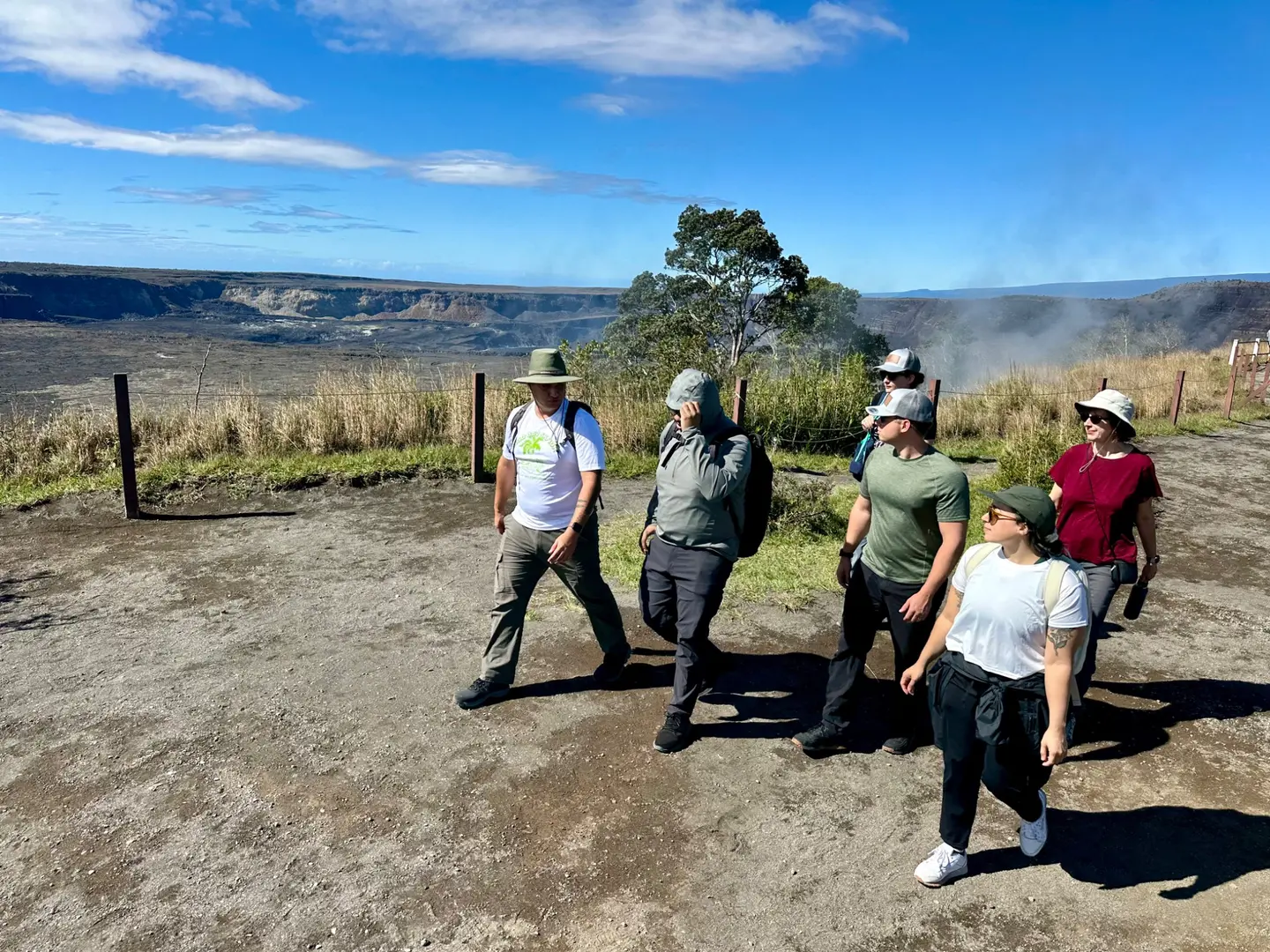
I led a six-person visiting team through a field collaboration in Hawaiʻi, translating shared learning into partnership strategy while keeping authorship, authority, and institutional responsibility clear.
Read the field storyWebb Community Events connected national mission infrastructure with hundreds of local hosts, scientists, engineers, and communities across all 50 states and Puerto Rico.
Trace the activation systemNow / 03
Current question
How should audience knowledge enter a science product before drafting begins?
I’m exploring how educator-led audience framing can become a clearer shared starting point for science explainers without turning context into a rigid template.
Audience strategy · science interpretation · evaluation · partner systems
Ed.M., Harvard Graduate School of Education · 2026
The Echo Jar · wonder, memory, uncertainty, attention
Voice / 04
“What Held” · HGSE Convocation 2026
Attention is a form of care. Making room is part of the work.
I was selected as one of three student speakers for the Harvard Graduate School of Education Convocation. The speech asked what becomes possible when rigor, attention, and generosity are treated as part of the infrastructure of learning.
Read the full speech at HarvardContinuity / 05
I am a Puerto Rican, first-generation educator and systems thinker. My own higher-education path began at Northampton Community College before continuing through the University of Pittsburgh, Georgetown, and Harvard. That route shaped the questions I still ask about recognition, belonging, access, and whether institutions make movement possible in practice.
Read the longer path