Yesenia Pérez

Inquiry / 00 · Harvard 2024–2026

When does learning actually count?

I study the point where learning meets institutional authority: who can recognize it, what that recognition obligates an institution to do, and whether a learner can rely on the promise after the learning has already happened.

Thesis / 01

Recognition makes learning visible. Application makes learning move.

When Does Learning Count? Recognition, Authority, and Binding Pathways in U.S. Higher Education examined apprenticeship-to-degree pathways as a governance problem. A learner can complete the work, demonstrate mastery, earn a credential, and still discover that the learning does not satisfy anything consequential.

My independent study argues that the missing mechanism is binding recognition: a pre-committed institutional obligation to honor validated learning under defined conditions. Judgment does not disappear; it moves upstream into the design of standards, evidence, approval, and audit.

Scale cannot depend on heroics. Scale needs rules.

Where can the learner still be stopped?

The diagnostic follows one block of learning through seven conversions. Each handoff is a place where a pathway promise can gain force, lose force, or return risk to the learner.

  1. 01LearningWhat was learned?
  2. 02EvidenceHow is mastery shown?
  3. 03ValidationWho can judge it?
  4. 04TranslationHow does it become legible?
  5. 05RecordingWhere does it live?
  6. 06ApplicationWhat does it satisfy?
  7. 07AdvancementWhat becomes possible?

one validated block of learning

one named requirement

automatic application

Depth without portability. Portability without obligation.

Reach University

Embedded recognition

Reach redesigns the degree around workplace learning. Assessment and application are built into the model, so work counts inside the institution.

What it proves

Institutions can move judgment upstream and redistribute assessment authority.

What remains

Recognition that binds internally does not automatically travel to another institution.
RACC

Networked recognition

The Registered Apprenticeship–College Consortium helps apprenticeship learning travel through shared translation and credit-recognition structures.

What it proves

Systems can widen the legibility and portability of validated learning.

What remains

Recognized credit may still become elective credit, or return to case-by-case discretion.

The research moved from argument to usable intervention.

The work began with a governance question: who gets to say what counts as college? It ended with an Applied-Credit Reliability Diagnostic that follows credit until it becomes usable progress, or loses force.

01Frame the authority problem

Who Gets to Say What Counts as College? identified recognition as a governance problem disguised as educational innovation.

02Compare institutional models

Reach and RACC revealed two partial solutions: deep internal application and broad external portability.

03Build the Credit Journey Map

The diagnostic traces who controls each conversion from learning to advancement and tests whether each rule is visible, binding, maintained, and appealable.

04Measure applied-credit yield

The framework separates credit awarded from credit that actually satisfies a named requirement, revealing where a pathway transfers risk back to the learner.

05Change one rule

The proof of concept is intentionally narrow: one validated learning block, one receiving program, one named requirement, and an application rule learners can trust.

Register / selected scholarship

Three inquiries. One institutional lens.

The wider body of work spans higher education, nonprofit finance, negotiation, science communication, and leadership. These pieces most clearly show how I move from structural question to usable intervention.

S999

When Does Learning Count?

A governance analysis of apprenticeship-to-degree pathways arguing that durable scale requires binding recognition, not institutional goodwill after the learning is complete.

Tool

Credit Journey Map

An Applied-Credit Reliability Diagnostic locating where credit changes status, who controls the change, and whether pathway promises become usable credential progress.

BA027

Budgeting for Trust

Using the Physics of Pō collaboration and the American Astronomical Society, I examined how budgets obscure relational labor, and how finance can make cultural integrity, resilience, and mission accountability visible.

See the research in the wider practice →

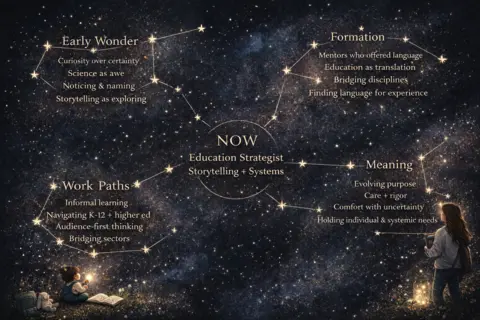
Yesenia’s personal career map drawn as constellations connecting early wonder, formation, work paths, meaning, and her current practice as an education strategist

Integrative view

Storytelling + systems.

My personal career map became a synthesis of the degree: early wonder, community college and transfer, professional formation, work paths, and meaning converging in a practice built around education strategy and storytelling.

The throughline is not a sector. It is a way of seeing: follow the learner, locate the rule, study who holds authority, and design conditions in which people can move with dignity.

Five commitments sharpened at Harvard.

Move judgment upstream.

Rigor is strengthened when standards, evidence, authority, and application are decided clearly before an individual must petition.

Design beyond navigation.

Equity cannot mean teaching people to survive broken processes more skillfully. Systems should reduce the need for heroic navigation.

Treat belonging as infrastructure.

Belonging frees cognitive bandwidth; credible signals of mattering stabilize identity and make authorship possible.

Ask what rule the number creates.

Metrics and agreements allocate risk. A system becomes legible when we identify who is protected and who becomes the flexible variable.

Let reflection change the design.

Reflection is not retreat from action. It is disciplined interpretation that protects complexity from being flattened by urgency.

Voice / after the analysis

Learning is not just about mastery, but about what we are willing to hold open for one another.

At HGSE Convocation, “What Held” carried the analytical questions back into public voice: attention as care, making room as part of the work, and people with full lives making space for one another.

Read the full speech at Harvard ↗

Return to the atlas →